About the Story
The story of Pyramus and Thisbe is a familiar one — it is what Shakespeare based Romeo and Juliet on. The Roman poet Ovid retold the story from earlier versions in his 1st century BCE epic poem the Metamorphoses. In his version, Pyramus and Thisbe live in a high-walled village in Babylon (modern-day Iraq), in houses that share a wall. They are teenagers who fall in love but are, for reasons Ovid does not divulge, forbidden from marrying by their parents. Through the secret methods of would-be lovers, they plan to meet outside the village walls — where tragedy befalls them both through rash actions based on foolish assumptions.
Interactive Illustration
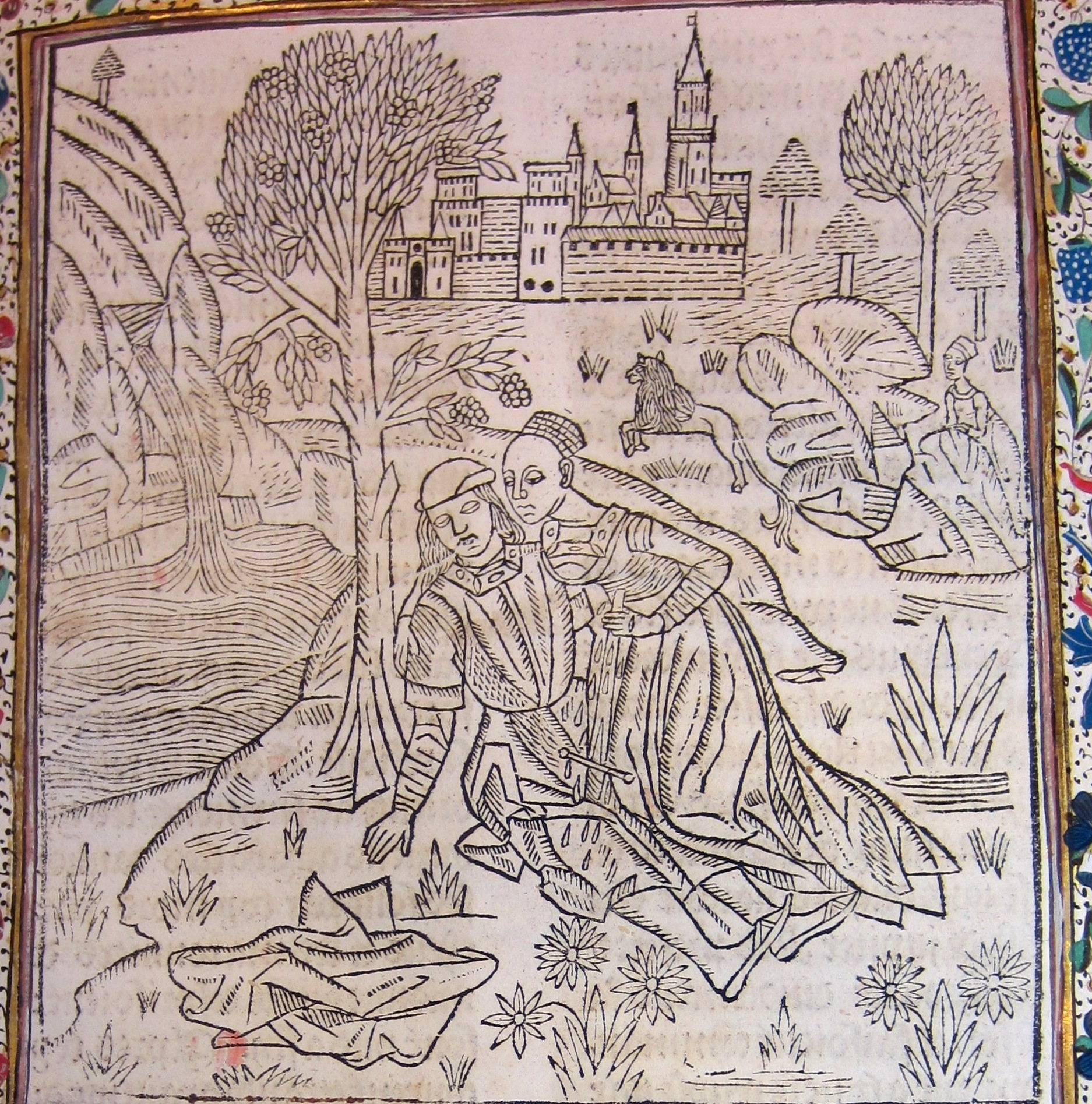
- altam urbem muristhe high city with walls
- sub umbra arborisunder the shade of a tree
- morus contermina fontimulberry tree bordering a spring
- ecce leanabehold the lioness
- Thisbe fugit in obscurum antrumThisbe fled into a dark cave)
- sanguine tinctam [Pyramus] repperit[Pyramus] found [it] stained with blood
- [Pyramus] demisit in ilia ferrum[Pyramus] drove the sword into his side
- amplexaque corpus amatumembracing the beloved body
- [Thisbe] incubuit ferro[Thisbe] fell upon the sword
from Ovid's Metamorphoses, lines 4.55–166 — text from The Latin Library
Pyramus et Thisbe, iuvenum pulcherrimus alter,55
altera, quas Oriens habuit, praelata puellis,
contiguas tenuere domos, ubi dicitur altam
coctilibus muris cinxisse Semiramis urbem.
... lateantque sub umbra
arboris: arbor ibi niveis uberrima pomis,
ardua morus, erat, gelido contermina fonti.90
.... venit ecce recenti
caede leaena boum spumantes oblita rictus,
depositura sitim vicini fontis in unda;
quam procul ad lunae radios Babylonia Thisbe
vidit et obscurum timido pede fugit in antrum,100
dumque fugit, tergo velamina lapsa reliquit.
...ut vero vestem quoque sanguine tinctam107
repperit, "una duos" inquit "nox perdet amantes,
e quibus illa fuit longa dignissima vita;
quoque erat accinctus, demisit in ilia ferrum,
nec mora, ferventi moriens e vulnere traxit.120
sed postquam remorata suos cognovit amores,
percutit indignos claro plangore lacertos
et, laniata comas amplexaque corpus amatum,
miscuit, et gelidis in vultibus oscula figens
"Pyrame," clamavit...
dixit et, aptato pectus mucrone sub imum,162
incubuit ferro, quod adhuc a caede tepebat.
Note
About this Page and Future Development
This page was developed as a programming task to create a rollover image, with the intention of building a reading aid for students in intermediate Latin studying Ovid's poetry. As a learning aid, the design would be more effective if the image responded to individual words or phrases in the text as they are rolled over. Adding audio narration may also increase learner engagement.